



Early 2 Factor (E2F)
The Early 2 Factors (E2Fs) are a family of eight winged-helix transcription factors that are key to regulating cell cycle progression from G1 to S phase among other functions. E2F1, E2F2, and E2F3a are expressed in early G1 through S phase and are believed to promote S phase initiation by activating genes involved in the G1 to S phase transition18. E2F3b, E2F4, E2F6, E2F5, E2F7, and E2F8 act as repressors and are expressed later in the cell cycle. E2Fs participate in myriad cell biological processes including: the cell cycle, DNA repair, apoptosis, development, differentiation, and metabolism.
All Product Categories
-
Early 2 Factor (E2F) Related Products (13)
Related Products (13)

-
Antibodies (4)
- 1
-
HLM006474
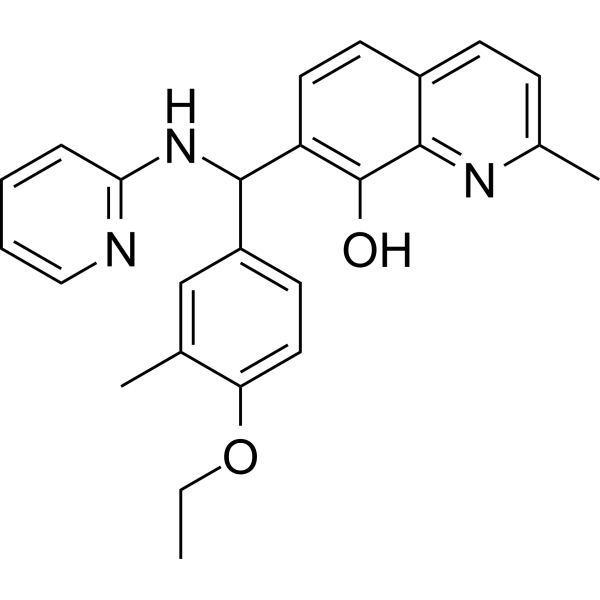 0 ImagesHLM006474 is a pan E2F inhibitor, which inhibits E2F4 DNA-binding with an IC50 of 29.8 μM in A375 cells.
-
LL-K8-22
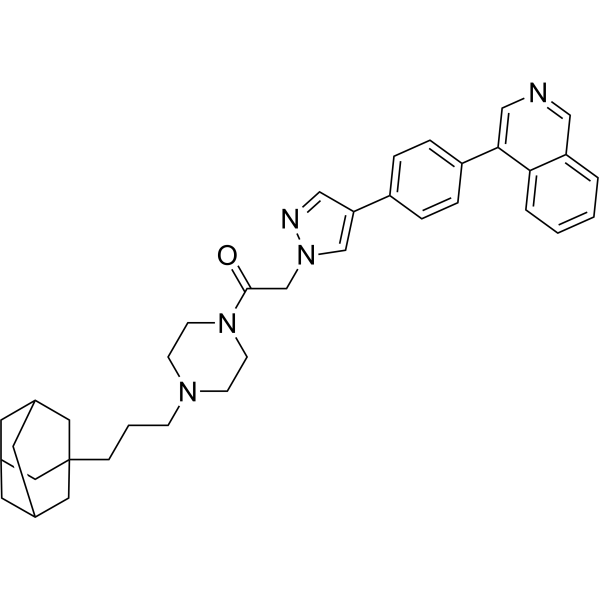 0 ImagesLL-K8-22 is a dual degrader of CDK8 and cyclin C HyT, with DC50 values of 2.52 μM and 2.64 μM, respectively. LL-K8-22 inhibits phosphorylation of STAT1 Ser 727, phosphorylation of the C-terminal domain Ser 2/5 of RNA polymerase II, and phosphorylation of Rb. LL-K8-22 represses E2F- and MYC-driven transcriptional programs and exhibits antiproliferative effects. LL-K8-22 synchronously induces proteasome-dependent selective degradation of CDK8 and cyclin C without degrading CDK19, other CDK family members, or other cyclins. LL-K8-22 can be used in the research of triple-negative breast cancer and colon cancer.
-
U7D-1
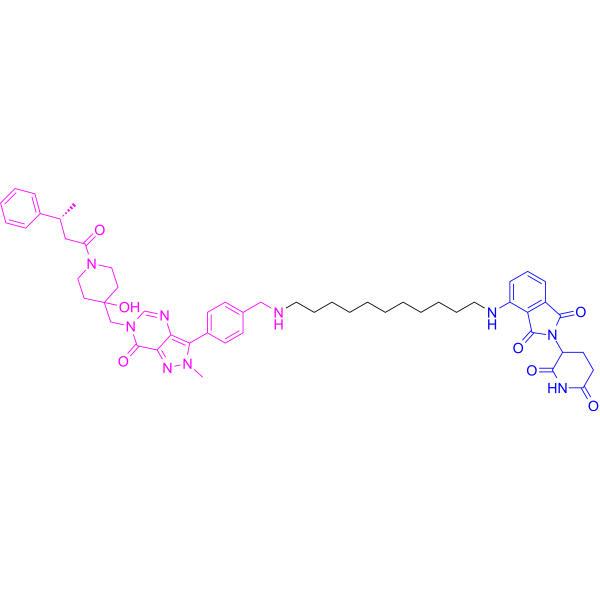 0 ImagesU7D-1 is a USP7 PROTAC degrader that induces selective proteasomal degradation of USP7. U7D-1 destabilizes and downregulates the expression of variant PRC1 complex subunits PCGF1, RING1A and PCGF6, and also slightly reduces the protein level of KDM2B. U7D-1 decreases cell viability, arrests neuroblastoma cells at the G0/G1 cell cycle phase, and downregulates the expression of target genes of PAX3::FOXO1 in FP-RMS cells. U7D-1 increases the level of cleaved PARP in FP-RMS cells, induces cell apoptosis, and upregulates the expression of muscle differentiation markers MYH1 and MYF5. U7D-1 inhibits the growth and proliferation of p53 wild-type and mutant cancer cells, and regulates the apoptosis pathway and E2F pathway. U7D-1 is applicable to studies on neuroblastoma, fusion-positive rhabdomyosarcoma, p53-mutant cancers and cancer-related research.
-
Q901
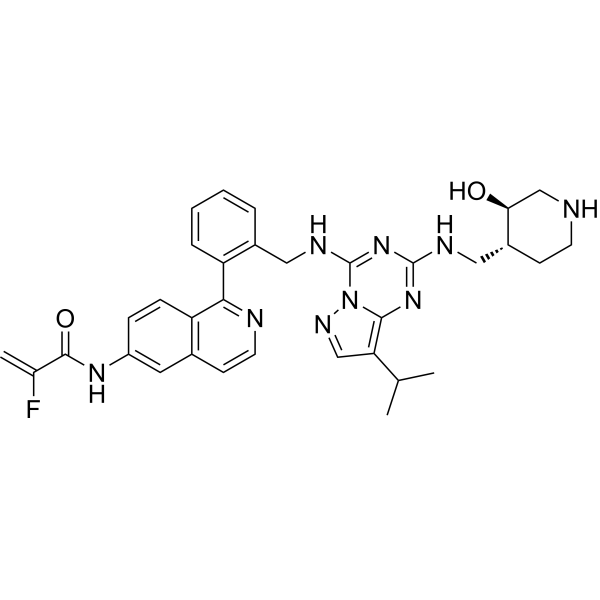 0 ImagesCat. No.: HY-153278CAS No.: 2766124-39-2Synonyms: CDK7-IN-21Q901 (CDK7-IN-21) is a selective and potent CDK7 inhibitor with an IC50 of 10 nM. Q901 disrupts MYC and E2FTOP1-DPCs and sensitizes tumor to TOP1 inhibitors by suppressing RNAPII transition from initiation to elongation. Q901 can inhibit tumor growth and significantly enhances tumor growth inhibition combined with TOP1 inhibitors. Q901 can be used for the research of cancer, such as colon cancer and lung cancer.
-
Q901 TFA
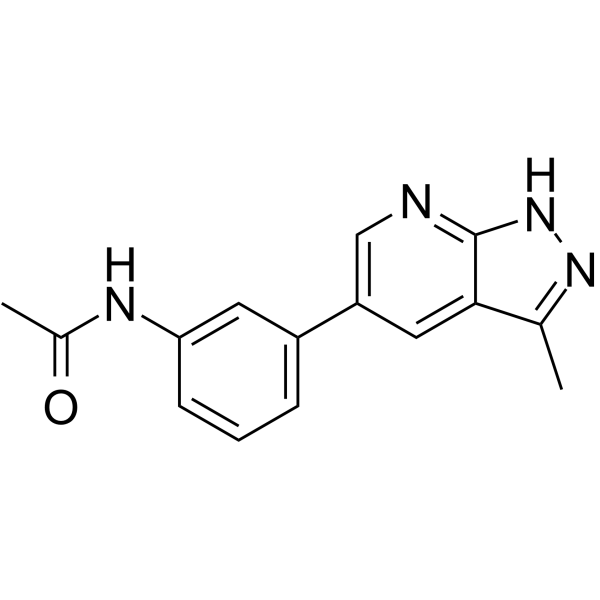
 0 ImagesCat. No.: HY-153278APurity: 98.55%Synonyms: CDK7-IN-21 TFAQ901 (CDK7-IN-21) TFA is a selective and potent CDK7 inhibitor with an IC50 of 10 nM. Q901 TFA disrupts MYC and E2FTOP1-DPCs and sensitizes tumor to TOP1 inhibitors by suppressing RNAPII transition from initiation to elongation. Q901 TFA can inhibit tumor growth and significantly enhances tumor growth inhibition combined with TOP1 inhibitors. Q901 TFA can be used for the research of cancer, such as colon cancer and lung cancer.
-
Edifoligide
 0 ImagesCat. No.: HY-177627CAS No.: 328538-04-1Synonyms: CGT 003Edifoligide is a decoy oligonucleotide that binds to and inhibits E2F transcription factors and thus may prevent neointimal hyperplasia and vein graft failure
-
Ly101-4B
 0 ImagesCat. No.: HY-164184CAS No.: 1415728-94-7Ly101-4B is an apoptosis inducer and multi-target inhibitor with antiproliferative, antitumor and cycytotoxic effects. Ly101-4B reduces HSF1 expression, inhibits microRNA-214 synthesis, downregulates HSP27, HSP70 and HSP90 expression, while suppressing E2F-dependent transcriptional activity and downregulating its target genes. Ly101-4B induces caspase 3/7-mediated apoptosis by reducing DNA synthesis, inhibiting the cell cycle and G1/S phase transition, without affecting RNA synthesis or inducing necrosis. Ly101-4B is selective for pancreatic ductal adenocarcinoma cells with different genotypes and varying degrees of E2F dependence. Ly101-4B can be used in research related to epithelial ovarian cancer and pancreatic ductal adenocarcinoma.
-
Edifoligide sodium
 0 ImagesCat. No.: HY-177627ASynonyms: CGT 003 sodiumEdifoligide sodium is a decoy oligonucleotide that binds to and inhibits E2F transcription factors and thus may prevent neointimal hyperplasia and vein graft failure
-
PROTAC PRMT3 degrader 1
 0 ImagesCat. No.: HY-159728PROTAC PRMT3 degrader 1 is a selective PRMT3 PROTAC degrader with a DC50 of 2.566 μM. PROTAC PRMT3 degrader 1 forms a ternary complex with MDM2 E3 ubiquitin ligase to induce proteasomal and neddylation-dependent degradation of PRMT3. PROTAC PRMT3 degrader 1 activates intrinsic apoptosis, endoplasmic reticulum stress signaling pathways. PROTAC PRMT3 degrader 1 downregulates E2F, MYC, oxidative phosphorylation pathways. PROTAC PRMT3 degrader 1 reduces cellular asymmetric dimethylarginine (ADMA) levels. PROTAC PRMT3 degrader 1 inhibits acute leukemia cell growth. PROTAC PRMT3 degrader 1 acts with glycolysis inhibitor 2-DG to reduce ATP production, induce intrinsic apoptosis, drive synergistic antiproliferative effects. PROTAC PRMT3 degrader 1 can be used for the research of acute leukemia.
-
Dth
 0 ImagesCat. No.: HY-175397Synonyms: DFHBI-thalidomideDth (DFHBI-thalidomide) is an RNA aptamer-based PROTAC degrader. Dth can degrade a variety of endogenous proteins (such as mCherry, p50, p65 and E2F1) by replacing the 3′ module on the RNA scaffold with the RNA aptamer corresponding to the target protein. Dth upregulates IκB-α and Bax, and downregulates Bcl-2 and VEGF. Dth generates green fluorescence upon binding to the Broccoli RNA aptamer, enabling the tracing of RNA scaffolds. Dth can be used in cancer-related research.
-
JR4-187
 0 ImagesCat. No.: HY-182241CAS No.: 2446965-01-9JR4-187 is an orally active, copper-dependent anticancer agent. JR4-187 downregulates genes involved in oxidative phosphorylation, MYC targets and E2F targets in cancer cells, while upregulates genes involved in the TNF-α signaling pathway, p53 pathway and KRAS signaling pathway, and downregulates CTR1 protein. JR4-187 induces ROS production, apoptosis, copper-dependent cytotoxicity, and exhibits selective cytotoxicity against KRAS-mutant cancer cells. JR4-187 is well tolerated in mouse models of pancreatic cancer. JR4-187 can be used in research related to cancers such as pancreatic ductal adenocarcinoma, colon cancer and rectal cancer.
-
JAS239
 0 ImagesCat. No.: HY-123612JAS239 is a blood-brain barrier-permeable ChoK inhibitor. JAS239 inhibits phosphocholine synthesis and reduces the expression level of E2F1 protein. JAS239 exhibits near-infrared fluorescence properties. JAS239 exerts anti-tumor activity against glioblastoma. JAS239 can be used in studies related to glioblastoma.
- 1




